The largest slave traders in Amsterdam

Ramona Negrón, Jessica den Oudsten, De grootste slavenhandelaren van Amsterdam: Over Jochem Matthijs en Coenraad Smitt

Amsterdam’s largest slave traders | Walburg Press

(The largest slave traders in Amsterdam. About Jochem Matthijs and Coenraad Smitt)
The 1730s were a turning point in the history of slavery in the Netherlands: the Dutch West India Company lost its monopoly on the transatlantic slave trade, so several traders in the Republic decided to use their ships for the private slave trade. Jochem Matthijs and Coenraad Smitt are among them. In more than thirty years, they shipped between 11,000 and 13,000 enslaved people from West Africa to Suriname.

Based on the voyage of one of the first private slave ships, ‘t Gezegende Suikerriet (1743-1745), Ramona Negrón and Jessica den Oudsten tell the hitherto unknown story of the enslaved people and crew members on board, the plantation owners involved in Suriname and the working methods of Amsterdam’s largest slave traders.
Matthias Lukkes writes a review of the book in the August 2024 issue of the IJMH. Read it at this link (subscription needed):

https://doi.org/10.1177/08438714241264626

The Bay of La Isabela

Check out in the August 2024 issue of the IJMH the paper by Alfredo Bueno Jiménez, “The bay of La Isabela, Dominican Republic: The first enclave for the shelter, reception, construction and maintenance of ships in the New World, 1494–1498”

https://doi.org/10.1177/08438714241261807

La Isabela emerged as the first node or point of commercial connection between the ancient kingdoms of Spain and the Caribbean. This achievement was due to the meticulous spatial arrangement and planning of the settlement in the Isabeline cove, designed to facilitate interaction with both the surrounding environment and the maritime routes. Christopher Columbus achieved effective intercommunication between resource-rich areas strategically located for both maritime and river navigation. The subsidiary station of Marta, located in the Bajabonico Valley, played a crucial role as a complement to the residential centre of El Castillo, providing the basic inputs necessary for the functioning of the settlement and the shipbuilding industry. Additionally, the adjacent bay, with its arched configuration, served as a resting and recuperation place for the crew. At the opposite end, to the north-east, the shipyard was located in the La Playa area, equipped with personnel, resources and sufficient infrastructure for the construction, outfitting and repair of vessels.

The Sun King at Sea

A review of Meredith Martin and Gillian Weiss, The Sun King at Sea: Maritime Art and Galley Slavery in Louis XIV’s France, is published in the August 2024 issue of the IJMH by Pauline Rocca

Read it at this link (requires subscription):

https://doi.org/10.1177/08438714241261795

This richly illustrated volume, the first devoted to maritime art and galley slavery in early modern France, shows how royal propagandists used the image and labor of enslaved Muslims to glorify Louis XIV.

Mediterranean maritime art and the forced labor on which it depended were fundamental to the politics and propaganda of France’s King Louis XIV (r. 1643–1715). Yet most studies of French art in this period focus on Paris and Versailles, overlooking the presence or portrayal of galley slaves on the kingdom’s coasts. By examining a wide range of artistic productions—ship design, artillery sculpture, medals, paintings, and prints—Meredith Martin and Gillian Weiss uncover a vital aspect of royal representation and unsettle a standard picture of art and power in early modern France.

With an abundant selection of startling images, many never before published, The Sun King at Sea emphasizes the role of esclaves turcs (enslaved Turks)—rowers who were captured or purchased from Islamic lands—in building and decorating ships and other art objects that circulated on land and by sea to glorify the Crown. Challenging the notion that human bondage vanished from continental France, this cross-disciplinary volume invites a reassessment of servitude as a visible condition, mode of representation, and symbol of sovereignty during Louis XIV’s reign.

https://shop.getty.edu/products/the-sun-king-at-sea-maritime-art-and-galley-slavery-in-louis-xiv-s-france-978-1606067307?srsltid=AfmBOopxHkwJyxTEvel7_PC0mJfyn68yKU_ueyIcjBxyP8HyQQ66ZEIf

The shipbuilding industry in the Spanish Caribbean, 1400s–1700s

Alfredo Bueno Jiménez introduces a Forum discussion in the August 2024 issue of the IJMH: “Introduction: The shipbuilding industry in the Spanish Caribbean, 1400s–1700s: Construction, maintenance, supply of materials, and financing”

Despite the subject’s importance, historiography has overlooked the shipbuilding industry and its supplies in the Spanish Caribbean, hence the need for this forum. It contributes to naval historiography by offering four case studies that discuss shipbuilding activities in shipyards and the supply of materials, especially the main raw material – wood.

Check it (requires subscription) at this link:

https://doi.org/10.1177/08438714241264547

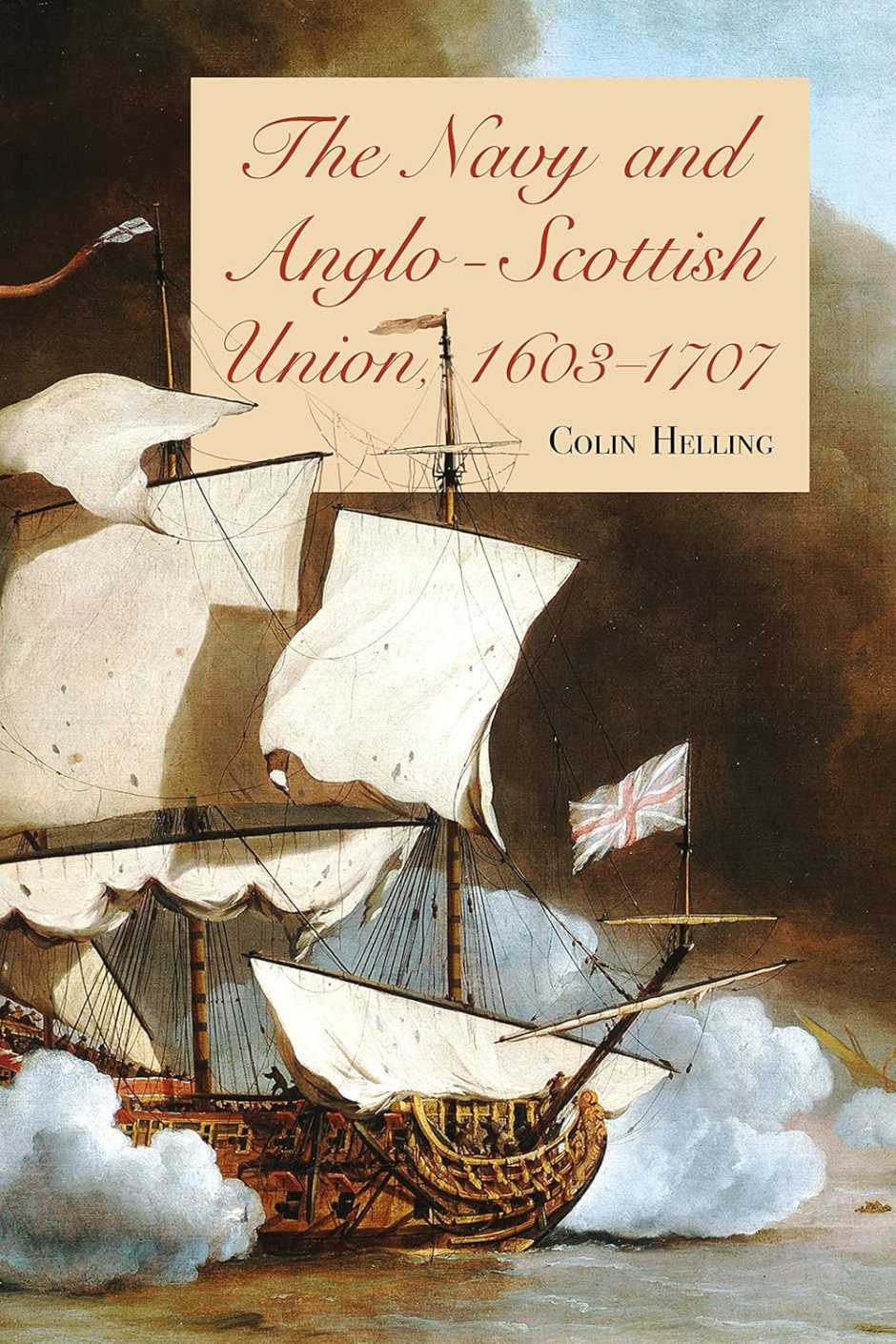
The Navy and Anglo-Scottish Union, 1603–1707 by Colin Helling

This book examines the union of England and Scotland by weaving the navy into a political narrative of events between the regal union in 1603 and the parliamentary union in 1707. For most of the century the Scottish crown had no separate naval force which made the Stuart monarchs’ navy, seen by them as a personal not a state force, unusual in being an institution which had a relationship with both kingdoms. This did not necessarily make the navy a shared organisation, as it continued to be financed from and based in England and was predominantly English. Nevertheless, the navy is an unusually good prism through which the nature of the regal union can be interrogated as English commanded ships interacted with Scottish authorities, and as Scots looked to the navy for protection from foreign invaders, such as the Dutch in the Forth in 1667, and for Scottish merchant ships trading with the Baltic and elsewhere. These interactions were often harmonious, but there were also many instances of tensions, particularly in the 1690s. The book illustrates both the ambiguous relationship between England and Scotland in the seventeenth century and also the navy’s under-appreciated role in creating the political union of Britain.

https://boydellandbrewer.com/9781783277049/the-navy-and-anglo-scottish-union-1603-1707/

Read the review by Steve Murdoch in the August 2024 issue of the IJMH
https://doi.org/10.1177/08438714241264934

Sound Toll records

“How do we measure the commodity flows of the Sound Toll records”,

Yrjö Kaukiainen on the recently published book by Werner Scheltjens. Read the piece in open access at this link: https://journals.sagepub.com/doi/full/10.1177/08438714241238076

Werner Scheltjens has estimated the commodity flows through the Sound by converting the original measures of the Sound Toll records into metric tons. The note discusses the merits and problems of this approach. It points out that weight units are not the best parameters from the viewpoint of shipping since the weight of the goods is poorly related to the actual requirement of shipping space.

The burden of complexity: Dealing with measurement and taxation in the Sound Toll registers – a response to Yrjö Kaukiainen

Werner Scheltjens replies to a research note outlining a method for the conversion of weights and measures in the Danish Sound Toll registers. Whereas Yrjö Kaukiainen argues that the use of values for Danish units of measurement is sufficient, Werner Scheltjens highlights the complexity of pre-modern weights and measures, and raises concerns about the simplification of the measurement and taxation procedures at the customs office in the Danish Sound.

https://journals.sagepub.com/doi/full/10.1177/08438714241238660

The export of Egyptian antiquities

“Mercantile networks and the export of antiquities from Egypt in the mid nineteenth century: A case study of Menkaure’s sarcophagus and the Beatrice” by Nicky Nielsen, in open access in the May 2024 issue of the IJMH. Read it at this link:

https://journals.sagepub.com/doi/full/10.1177/08438714241226841

The export of antiquities from Egypt to the United Kingdom during the mid nineteenth century required an extensive network of cultural, diplomatic and mercantile actors, including private shipowners. While much previous research has focused on the political stakeholders in the process, as well as the archaeologists conducting excavations in Egypt, the attempted export of Menkaure’s sarcophagus from Giza to the British Museum in 1838 allows for a closer examination of one of the private shipowners who was involved in this process – namely, Captain Richard Mayle Whichelo of the merchant vessel Beatrice. This article investigates the diplomatic processes that were required for the export of the sarcophagus and provides an overview of the history of the Beatrice and of Captain Whichelo, placing this within the broader context of the transport of antiquities during the nineteenth century.

Barbary captives

https://cup.columbia.edu/book/barbary-captives/9780231175258

In the early modern period, hundreds of thousands of Europeans, both male and female, were abducted by pirates, sold on the slave market, and enslaved in North Africa. Between the sixteenth and the early nineteenth centuries, pirates from Algiers, Tunis, Tripoli, and Morocco not only attacked sailors and merchants in the Mediterranean but also roved as far as Iceland. A substantial number of the European captives who later returned home from the Barbary Coast, as maritime North Africa was then called, wrote and published accounts of their experiences. These popular narratives greatly influenced the development of the modern novel and autobiography, and they also shaped European perceptions of slavery as well as of the Muslim world.

Barbary Captives brings together a selection of early modern slave narratives in English translation for the first time. It features accounts written by men and women across three centuries and in nine different languages that recount the experience of capture and servitude in North Africa. These texts tell the stories of Christian pirates, Christian rowers on Muslim galleys, house slaves in the palaces of rulers, domestic servants, agricultural slaves, renegades, and social climbers in captivity. They also depict liberation through ransom, escape, or religious conversion. This book sheds new light on the social history of Mediterranean slavery and piracy, early modern concepts of unfree labor, and the evolution of the Barbary captivity narrative as a literary and historical genre.

Daniel J. C. Brooks publishes a review in the May 2024 issue of the IJMH (subscription needed). You can read it at this link: https://journals.sagepub.com/doi/abs/10.1177/08438714241230405

Reckoning with Slavery 

https://www.dukeupress.edu/reckoning-with-slavery

In Reckoning with Slavery Jennifer L. Morgan draws on the lived experiences of enslaved African women in the sixteenth and seventeenth centuries to reveal the contours of early modern notions of trade, race, and commodification in the Black Atlantic. From capture to transport to sale to childbirth, these women were demographically counted as commodities during the Middle Passage, vulnerable to rape, separated from their kin at slave markets, and subject to laws that enslaved their children upon birth. In this way, they were central to the binding of reproductive labor with kinship, racial hierarchy, and the economics of slavery. Throughout this groundbreaking study, Morgan demonstrates that the development of Western notions of value and race occurred simultaneously. In so doing, she illustrates how racial capitalism denied the enslaved their kinship and affective ties while simultaneously relying on kinship to reproduce and enforce slavery through enslaved female bodies.

Graham Kerr publishes a review in the May 2024 issue of the IJMH (subscription needed). You can read it at this link: https://journals.sagepub.com/doi/abs/10.1177/08438714241230399

Entrepôt of Revolutions

The Age of Revolutions has been celebrated for the momentous transition from absolute monarchies to representative governments and the creation of nation-states in the Atlantic world. Much less recognized than the spread of democratic ideals was the period’s growing traffic of goods, capital, and people across imperial borders and reforming states’ attempts to control this mobility.

Analyzing the American, French, and Haitian revolutions in an interconnected narrative, Manuel Covo centers imperial trade as a driving force, arguing that commercial factors preceded and conditioned political change across the revolutionary Atlantic. At the heart of these transformations was the “entrepôt,” the island known as the “Pearl of the Caribbean,” whose economy grew dramatically as a direct consequence of the American Revolution and the French-American alliance. Saint-Domingue was the single most profitable colony in the Americas in the second half of the eighteenth century, with its staggering production of sugar and coffee and the unpaid labor of enslaved people. The colony was so focused on its lucrative exports that it needed to import food and timber from North America, which generated enormous debate in France about the nature of its sovereignty over Saint-Domingue. At the same time, the newly independent United States had to come to terms with contradictory interests between the imperial ambitions of European powers, its connections with the Caribbean, and its own domestic debates over the future of slavery. This work sheds light on the three-way struggle among France, the United States, and Haiti to assert, define, and maintain “commercial” sovereignty.

Drawing on a wealth of archives in France, the United States, and the United Kingdom, Entrepôt of Revolutions offers an innovative perspective on the primacy of economic factors in this era, as politicians and theorists, planters and merchants, ship captains, smugglers, and the formerly enslaved all attempted to transform capitalism in the Atlantic world.

Tessa de Boer publishes a review in the May 2024 issue of the IJMH (subscription needed). You can read it at this link:

https://journals.sagepub.com/doi/abs/10.1177/08438714241230393